monticello_bird_club_charlottesville_virginia

Regular monthly meetings with invited speakers and time for socializing are held on the second Thursday of each month, September through June, at 7:30 PM in Ivy Creek Natural Area Education Building. Please note our new location. The Ivy Creek Natural Area is located on Earlysville Road, about one-half mile from the intersection of Hydraulic Road and West Rio Road, just before the Reservoir.  Bring your binoculars and enjoy some birding before the meeting.

Click here for a map to the Ivy Creek Natural Area.

A different speaker each month will talk about birds or broader topics relating to natural history and the environment. The MBC does not schedule meetings during the summer months of July and August.

For more information or directions to find us, contact Jim Nix at 434-973-7366,
jim-nix@comcast.net, or Ron Kingston at 293-5173, kingston@cstone.net .


2008 - 2009 Speakers Schedule

See our current newsletter for more information about this months meeting.

September 11, 2008,“Chasing Birds across Texas” by Mark Adams

 In the year 2000, while living in the Davis Mountains of west Texas, Mark Adams did a birding Big Year in the Lone Star state, recording 489 species of birds. Mark’s presentation for the Monticello Bird Club’s meeting on Thursday, 11 September, will describe many of his interesting and often unexpected Big Year experiences, a wide range of Texas habitats, and (of course!) the state’s birds. Mark chronicled his Big Year in a book published in 2003 by Texas A&M University Press titled “Chasing Birds across Texas: A Birding Big Year.”

 Mark Adams is a professional astronomer who works for the National Radio Astronomy Observatory (NRAO) in Charlottesville, Virginia, where he is the Assistant Director for Education & Public Outreach. 

Mark was born in Baltimore, and was raised in Maryland and Pennsylvania. He received an undergraduate astronomy degree from the Pennsylvania State University then attended the University of Arizona, where he completed his Ph.D., also in astronomy. After 13 years working in the defense industry in Florida, Mark returned to astronomy in 1994 when be became the Site Director for the University of Texas - McDonald Observatory in the Davis Mountains of west Texas. Mark moved to Charlottesville and the NRAO in January 2004.   

Mark became interested in birds in 1995 while living in West Texas. In the year 2000, Mark did a birding Big Year in Texas, traveling across the entire state, visiting a great variety of places and habitats, and recording 489 species of birds. Mark chronicled his Big Year in a book published in 2003 by Texas A&M University Press titled “Chasing Birds across Texas.” Mark’s next book is about citizen science and will be published by Texas A&M University Press in spring 2010. Mark has also written popular articles on astronomy and natural history, and book reviews.

October 9, 2008, Clair Mellinger, Northern Saw-whet Owls in northwestern Virginia"

  I taught various ecology, botany, and field biology courses (including   ornithology) at Eastern Mennonite University for over 35 years. I retired   in 2007. I am an active member of the Rockingham Bird Club and have   served in various functions in the past but currently serve as the Records   Committee Chair ... at least I keep the records for the club. In that  capacity I edited and wrote a small book called the Birds of Rockingham   County. (I will bring a few along for purchase if anyone is interested.)  I have also served the VSO as President, Murray Award Committee   Chair, and other capacities. My current research with saw-whet owls will   be the subject of the program.

 
November 13, 2008, Teta Kain, “Antarctic Ice—The Ultimate Adventure.”

In the autumn of 2002, Teta Kain, along with three friends, spent 17 days on a ship plying the Antarctic seas looking for those for those special birds found primarily near the Antarctic Circle. This trip is a little different from the usual sub-polar adventure story in that the party left from Cape Town South Africa and ventured hundreds of miles south across the the 40th and 50th parallels to reach the pack-ice that surrounds the continent of Antarctica. You won’t soon forget the wild ocean, breath-taking icebergs, beautiful seabirds and the remote sub-antarctic islands in this once-in-a-lifetime story that Teta tells.
Teta Kain has been a wildlife photographer for over 35 years, and although she has traveled extensively throughout the United States, and especially in Virginia, photographing everything from bugs to birds, the Antarctica trip was her first trip out of our country. Teta has been involved with nature and environmental organizations ever since she arrived in Virginia 25 years ago. She is the current president of the Virginia Society of Ornithology. She is also president an environmental group on Virginia’s Middle Peninsula, dedicated to preserving the unique and pristine river known as Dragon Run. She served as a board of directors member and field trip chairman for the Butterfly Society of Virginia, along with performing various volunteer duties for the Alliance for the Chesapeake Bay and the Chesapeake Bay National Estuarine Research Reserve based at the Virginia Institute of Marine Science.

December 11, 2008, Annual Christmas Party. Charles Ziegenfus will present: Acorns, Chipmunks, and Ground Nesting Birds.

He will be talking briefly about the distribution of juncos inNorth America and in particular the breeding biology of juncos at the higher elevations near the University of Virginia's Mountain Lake Biological Research Station, west of Blacksburg. Nesting success for ground nesting birds often fluctuates, some times dramatically from year to year. The presentation will focus attention on how the variability in mast crop(acorns) relates to rodent populations and the reproductive success of juncos.
Charles Ziegenfus is a Professor Emeritus of Mathematics and Adjunct Professor Emeritus in Biology. He has been a long time colleague of the Val Nolan and Ellen Ketterson (University of Indiana, Bloomington) research team at Mountain LAke Biological Research Station and a Research colleague of Dan Cristol, William and Mary for many years. During winter field work at Mountain Lake Biological Station homing abilities as well as spatial memory capabilities were studied between migratory and non-migratory juncos. He is also a research colleague of Clair Mellinger, studying Fall migration and wintering habitats of the Northern Saw-whet owl.
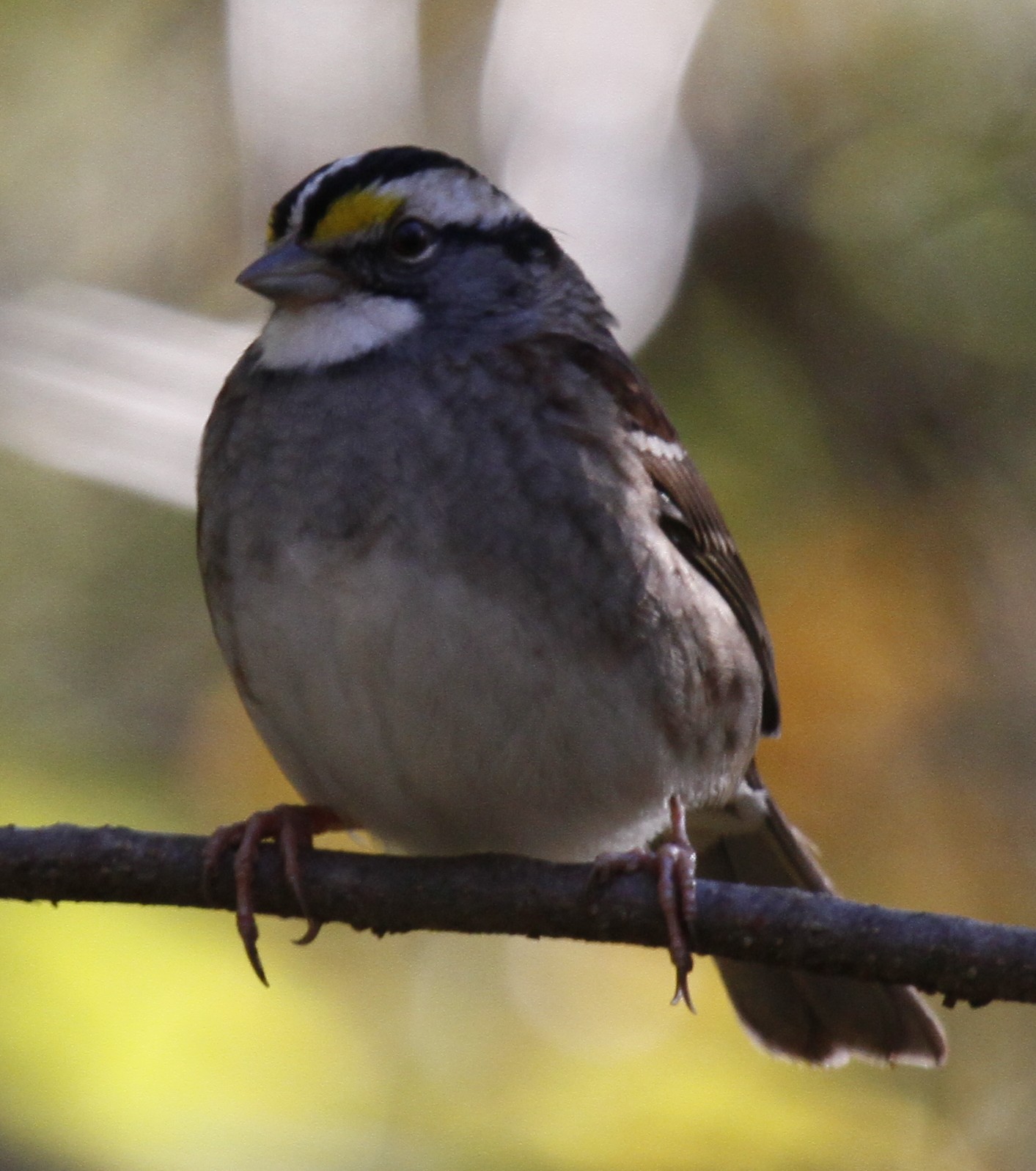
Currently he is doing winter population studies of White-throated sparrows and juncos with several JMU students. During the spring I teach the ornithology classes at JMU. Additionally he usually teaches one or two mathematics courses each semester.

January 8, 2009 ;Marc Puckett will give a talk titled "The Bobwhites and the Bees" which will explain why early-succession habitat is so important to a variety of species including quail. It will set the stage for a brief explanation of the Quail Action Plan, total about 30 - 35 minutes on Powerpoint.

Bio: BS VPI&SU 1992, forestry and wildlife, MS NCSU 1995, wildlife biology, employed by DGIF since 1996, currently the state's small game project leader and co-leader of the Quail Action Plan. Served as an infantry paratrooper from 1983 to 1987. Served as president of the Virginia Chapter of the Wildlife Society - 2003. Active in conservation since 1989, currently also involved in bio-fuels conservation efforts.

February  2009, Bob Schamerhorn,  "Through The Camera's Lens"

This slideshow program contains spectacular photographs of Virginia native species from the coastal region to the mountains; from the deep wilderness to backyard birds. Enjoy beautiful bird photography
  by nature photographer Bob Schamerhorn. Avian photography shared with his experience pertaining to nature photography. Bob's life-long passion for ornithology is apparent in each amazing image. New images added all the time.
   
 Bio:  The fascination and admiration of Natural History has been with me since the beginning. From the spring fed creeks in the woods behind my childhood stomping grounds, to the slopes of the Blue Ridge Mountains I explored as a youth, the wonder of nature has always captivated me. My thirst for knowledge about the natural world was quenched by angels. When I was ten, I was put under the wings of two of the kindest, most generous people I have ever met. Myriam Moore and her daughter Gene who were members of the Lynchburg Bird Club. They not only welcomed me into their home with generous hospitality, but also shared their extensive knowledge of Ornithology and Botany with me. They sparked in me a desire to learn more about the things that fascinated me, whether it was birds, reptiles, amphibians, butterflies or wildlife art, the Moores inspired and supported me in whatever interested me. In return, I would share my discoveries with them as we explored the world around us. My first exposure to nature photography was Myriam's dental camera that was used for close-up shots only, like a macro lens. Then an eighth grade photography class at Linkhorne Jr. High School in Lynchburg, Virginia taught me the fundamentals of composition and developing film. Later I purchased a used 35mm SLR camera and an print enlarger from a man I worked for in High School and set up a dark room in my parent's basement. Later I started as a biology major at Virginia Tech, and then switched to art and design by the start of the second semester. I am currently serving as the Education Chairperson for The RIchmond Audubon Society and work as a graphic artist.
  
Years went by and my fascination with the great outdoors remained. It was not until late in 2002 when I got my first digital camera that I began to regularly photograph wildlife. I think it was the freedom to take as many pictures as I wanted to, without the time and financial burdens of film, that rekindled my artistic vision though the camera's lens. Seeing how much enjoyment I was getting from nature photography, my amazing bride of over twenty years, Susan, indulged me with a birthday card that read, "Go to the camera store and get you a new camera and a big honkin' lens." That was the catalyst that helped bring about these images. This has led me to numerous adventures since then, where I have encountered many of God's amazing creatures in many beautiful places.

March 12, 2009, Birding Ecuador with Jim Nix and Phyllis Binder

Jim Nix grew up in New York City but has lived in Charlottesville since 1970.  He has been an avid birder since the early 1980s and a member of the Monticello Bird Club since its founding in 1986.  Birds of the American tropics became his special interest after a trip to Cost Rica in 1988.  Two other trips to Costa Rica followed and, since 1995, he and his wife, Phyllis Binder, have made twenty trips to Mexico and Central and South America.  In July 2007 they spent three weeks in Ecuador in the Andean highlands and the cloud forest zone on the western slope.  Only about a third of the time was spent birding but they saw nearly 150 bird species including 34 hummingbirds, 20 tanagers and three species of strange and secretive antpittas.  Ecuador is a land of spectacular scenery and fascinating culture as well as incredible birds and is quite safe and comfortable to visit.

April 9, 2009, Birding Wintergreen

Dr. Marshall Faintich is an astronomer by training, a cartographer by trade, and a student of ornithology, numismatics, archaeology, and history. He received his BS in Applied Mathematics from the University of Missouri at Rolla, and his MS and PhD in Astronomy from the University of Illinois. His work history includes satellite system studies, astrodynamics, remote sensing, digital cartography, and digital information analysis, and is a past National Director of the American Cartographic Association. He has taken more than 35,000 wildlife photos since December 2006, and has photographed 126 species of birds in the Wintergreen area, as well as other species of birds outside of the area. Many of his photos can be seen on his web site: http://www.symbolicmessengers.com/Wildlife_thumbnails.htm.

Dr. Faintich is the author of more than sixty technical papers, several articles and books on numismatics, and he is working on a local wildlife guide for Wintergreen and the Rockfish Valley. He teaches a short course in digital photography, bringing to his classes more than 35 years experience in computer processing of digital imagery. In addition, he is the senior birding editor for the Rockfish Valley Trail web site: http://www.rockfishvalley.org/birds/RVTrail_birding.htm


2006-2007
Board Members

President: Jennifer Gaden; jgaden@embarqmail.com
434-293-6275 

Vice President: Jim Hill; jimcarhill@comcast.net
434-975-6523

Secretary: Peggy Cornett; pcornett@monticello.org
434-984-9816 

Treasurer: Henry Konat,; henryk54@verizon.net
540-948-4771

Field Trips: John Zimmerman, jozimmva@embarqmail.com
434-974-9293.

Programs: Pat Wilczek, pat.wilczek@comcast.net
434-985-4444.

Publicity: Ellen Dudley, emdudley@nexet.net 
434-244-2688.

Hospitality: Priscilla Kingston; Kingston@cstone.net
434-293-5173 

Newsletter: Amy Gilmer;
akgilmer@comcast.net
434-825-2170

Membership: Jim Nix
jim-nix@comcast.net
434-973-7366 

Birdseed Sales; Jim Hill jimcarhill@comcast.net
434-975-6523

Newsletter Submissions:

 Deadline for submissions to the newsletter is the 18th of the month preceding publication. Please email information to Amy Gilmer at akgilmer@comcast.net
or call her at 825-2170.